Reducing my cognitive load on food#
A typical day leaves very little room for improvisation. Sleep, work, basic maintenance, the small rituals that keep a life running. They fill almost the entire 24‑hour cycle. When I looked closely at where my time was going, food turned out to be the largest flexible block. Not the eating itself, but everything around it: deciding what to make, checking what I have, preparing it, cleaning up afterward. It was a constant background process that consumed more time and attention than I wanted to give it.
I enjoy eating, and I want the food I eat to be nutritious and unprocessed [1]. But preparing that kind of food every single day takes time I don’t always have. Meal prepping became a way to reclaim that time without compromising on what I value. I’ve been doing so for almost a year now. It gives me predictable meals, predictable nutrition, and predictable effort. It removes the daily decision‑making and replaces it with a weekly session that stabilizes the rest of the week.
That’s the real reason I meal prep: it gives me back time and reduces noise.
Meal Prepping Basics#
Once I committed to meal prepping, I needed a way to keep track of what I had, what I needed, and what I was actually eating. A simple spreadsheet grew into a small workbook with sheets for foods, products, inventory, consumption, preps, meals, and recipes. It isn’t a system for its own sake, it’s just the easiest way to keep everything coherent.
Balancing macronutrients [2] is more precise than people assume. “Variety” in the nutritional sense is often misunderstood. The body doesn’t distinguish between fiber from oats or fiber from peas; it just processes fiber. The same is true for vitamins and minerals [3]. Once the nutritional bases are covered, the remaining differences are mostly about taste. The place where variety matters is contamination: arsenic in rice [4], heavy metals in tuna [5], the kinds of things that accumulate when you eat the same food repeatedly. Rotating foods reduces that exposure.
So my recipes are built around nutritional composition and predictability. They’re simple, repeatable, and easy to prepare in batches. The goal is stability, not novelty… A set of meals that reliably meets my nutritional needs without demanding daily attention.
The meals I prepare each week aren’t designed for bulking [9], cutting [10], or any other goal‑oriented nutrition plan. They’re simply built to cover my daily requirements in a stable, predictable way… A baseline [6]. Once that baseline is in place, the rest of the day becomes easier. I don’t have to think about whether I’m getting enough protein or fiber or micronutrients [7]. The foundation is already there.
If I need extra calories on a given day, I can improvise. A piece of fruit, a handful of nuts, an extra portion of grains. As long as I keep an eye on sugar and salt [8], the system stays balanced. The point isn’t precision for its own sake; it’s reducing the cognitive overhead of feeding a biological system that needs consistency more than novelty.
Meal prep gives me that consistency. It gives me a baseline I can trust, so the rest of my choices don’t have to be perfect, just reasonable…
How I Meal Prep#
I prepare everything on Sunday. It’s the one moment in the week where I can batch the work and remove it from the rest of my days. I calculate the total amount of each ingredient I need (usually five times the portion size) and cook the entire batch in one go.
Vegetables are the only part that require a bit of attention. Because I use frozen ones, blanching becomes a small timing exercise. I let the water come to a boil, add the vegetables, and give them a couple of minutes. I like them crunchy, so I’m careful with the timer.
Grains get washed several times before cooking. Fish goes into the oven. Chicken is grilled in a pan without oil. None of this is complicated; it’s just consistent.
Things that don’t need to be cooked I keep plain. Oats I tend to eat with lukewarm water only. Plain yoghurt, with some defrosted berries. Oils I actually drink, by emulsifying them in lukewarm water.
I take a supplement for iron, since I rarely eat red meats. Besides that, I supplement calcium, electrolytes, glutathione, collagen, and vitamins.
The cost is predictable too. Meats run around 25 €, vegetables around 5 €, grains another 5 €, and everything else: yoghurt, berries, supplements, about 5 €. In total, roughly 40 € a week. That’s about 8 € per day for meals that are stable, nutritious, and unprocessed, which is more than reasonable in 2026.
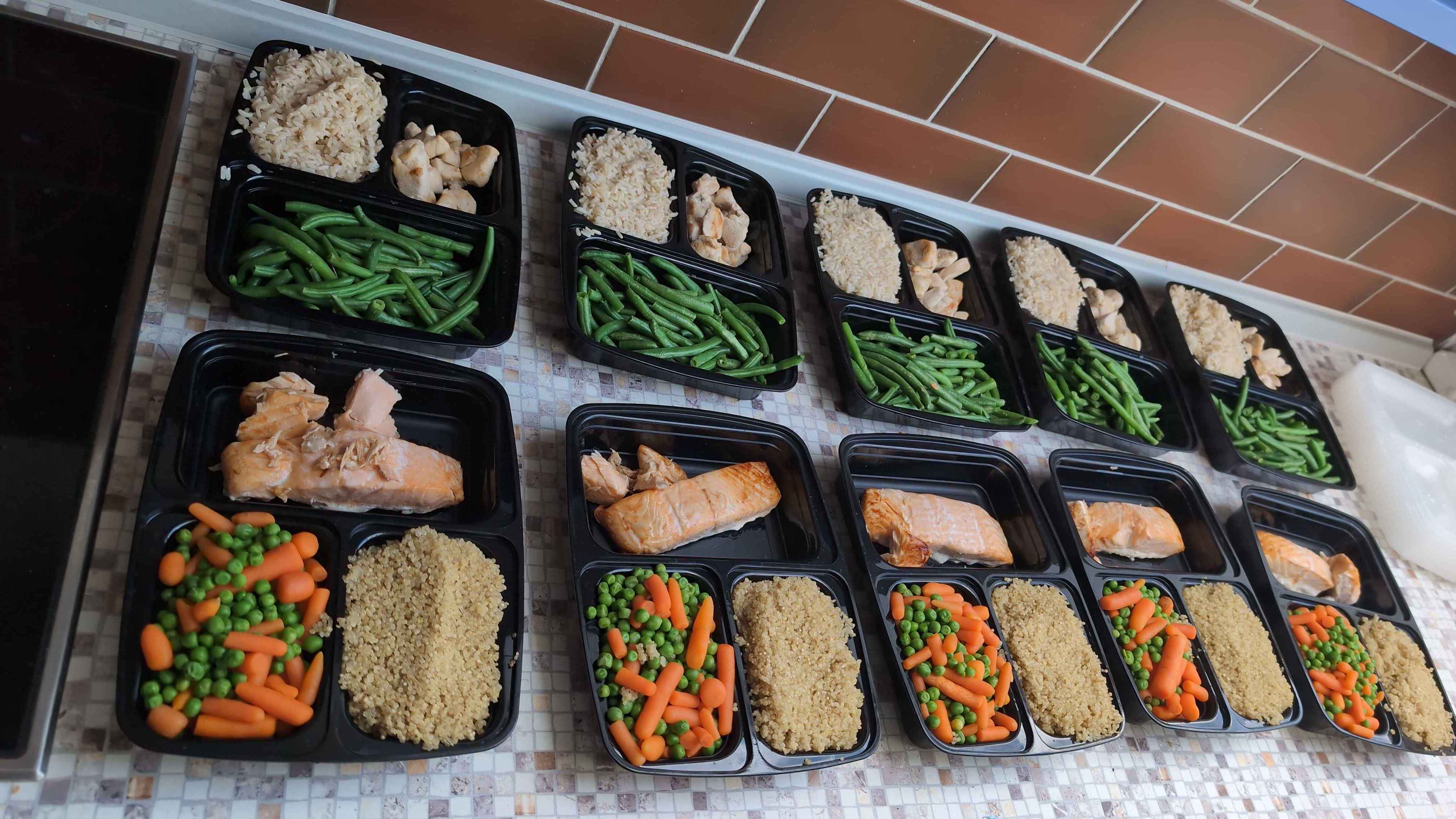
A typical week-worth prep of the two main meals#
Data#
This is a dump of the three relevant sheets for meal preparations. I will update it regulary.
Meal Preparations#
Prep ID |
Energy (kcal) |
Fat |
Fat (saturated) |
Carbohydrates |
Carbohydrates (Sugar) |
Fiber |
Protein |
Salt |
|---|---|---|---|---|---|---|---|---|
DEFAULT |
1970.85 |
60.37 |
13.665 |
171.1 |
23.295 |
#DIV/0! |
167.225 |
1.1999 |
Meals#
Prep ID |
Meal ID |
Meal Name |
Timing |
Energy (kcal) |
Fat |
Fat (saturated) |
Carbohydrates |
Carbohydrates (Sugar) |
Fiber |
Protein |
Salt |
|---|---|---|---|---|---|---|---|---|---|---|---|
DEFAULT |
TB |
Breakfast |
09:00:00 |
275.7 |
4.095 |
0.66 |
35.82 |
0.48 |
5.82 |
21.12 |
0.006 |
DEFAULT |
MMO |
Mid-Morning Olive |
11:00:00 |
229.8 |
13.95 |
1.95 |
0.24 |
26.4 |
|||
MMW |
Mid-Morning Walnut |
11:00:00 |
|||||||||
MMF |
Mid-Morning FlaxSeed |
11:00:00 |
|||||||||
DEFAULT |
BW |
Chicken-Rice |
13:30:00 |
661.7 |
9.155 |
2.495 |
65.7 |
3.575 |
#DIV/0! |
69.485 |
0.1959 |
DEFAULT |
AW |
Salmon-Quinoa |
18:30:00 |
698.65 |
27.92 |
5.11 |
62.14 |
12.04 |
12.2666666666667 |
43.02 |
0.773 |
DEFAULT |
TO |
Yoghurt Top-Up |
19:00:00 |
105 |
5.25 |
3.45 |
7.2 |
7.2 |
#DIV/0! |
7.2 |
0.225 |
Meal Recipes#
Amount (g) |
Energy (kcal) |
Fat |
Fat (saturated) |
Carbohydrates |
Carbohydrates (Sugar) |
Fiber |
Protein |
Salt |
||
|---|---|---|---|---|---|---|---|---|---|---|
TB |
Collagen Supplement |
15 |
53.1 |
0.075 |
0.12 |
13.2 |
||||
TB |
Oats |
60 |
222.6 |
4.02 |
0.66 |
35.7 |
0.48 |
5.82 |
7.92 |
0.006 |
MMO |
Olive Oil |
15 |
123.6 |
13.8 |
1.95 |
|||||
MMO |
Collagen Supplement |
30 |
106.2 |
0.15 |
0.24 |
26.4 |
||||
BW |
Chicken Breast |
160 |
316.8 |
6.88 |
1.92 |
59.2 |
0.1424 |
|||
BW |
Brown Rice |
85 |
292.4 |
2.125 |
0.425 |
58.65 |
0.425 |
3.74 |
7.735 |
0.0085 |
BW |
Princess Beans |
150 |
52.5 |
0.15 |
0.15 |
7.05 |
3.15 |
#DIV/0! |
2.55 |
0.045 |
AW |
Salmon |
150 |
320.25 |
22.5 |
4.35 |
28.5 |
0.075 |
|||
AW |
Quinoa |
80 |
291.4 |
4.72 |
0.56 |
49.44 |
2.74 |
5.46666666666667 |
10.02 |
0.038 |
AW |
Mixed Vegetables |
200 |
87 |
0.7 |
0.2 |
12.7 |
9.3 |
6.8 |
4.5 |
0.66 |
TO |
Yoghurt |
150 |
105 |
5.25 |
3.45 |
7.2 |
7.2 |
#DIV/0! |
7.2 |
0.225 |
Footnotes
Comments
Feel free to leave a public comment on my Reducing my cognitive load on food blog post.
Before you comment...
If you don't have an account at accounts.tiararodney.com yet, feel free to create one during sign in, after you've read and agreed to my Privacy and Acceptable Use Policy